

This page describes the advanced lab courses in the B.Sc. Physics as well as in the Physics Master programs and in the M.Sc. Quantum Science & Technology. Information on the advanced lab course in the M.Sc. Biomedical Engineering and Medical Physics can be found on the specific pages of the BEMP advanced lab course.
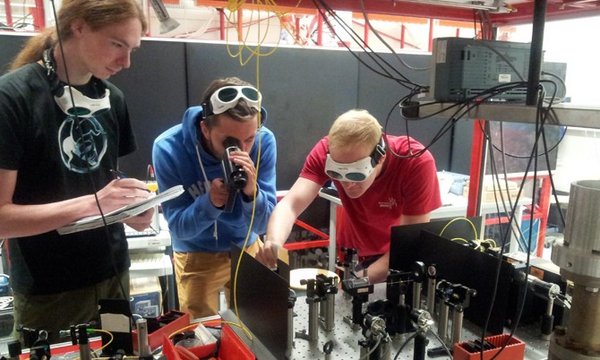
The experiments in the Advanced Lab Course are integrated into the experimental groups at the Physics Department and the participating Max-Planck institutes, where they are carried out. In addition LMU provides selected experiments exklusively for the students in M. Sc. Quantum Scinece & Technology. It is the ideal opportunity to learn a bit more about the research done in each place and to gain important information regarding the future specialization or the choice of the Bachelor's/Master's thesis.
Overall responsibility for the Advanced Lab Course is with Prof. Sharp and Prof. Schönert for the Physics programs and Prof. Brandt for the M. Sc. Quantum Science & Technology.
Safety Instruction
A safety instruction is obligatory for each participant before taking part at the advanced lab course and then at least once a year. The safety instruction including a test is done in an online Moodle-course.
The database containing the information on the safety instruction status of the participants is synchronized once a day with Moodle i.e. the warnings about missing safety instructions do not disappear immediately after passing the test in the online Moodle-course.
Finding a Team
The experiments in the Advanced Lab Course are done in teams of regularly three students. If sufficient places are available, as an exception an experiment can be done by two students. The experiments at LMU, exclusively available for students in M.Sc. Quantum Science & Technology, are also done in teams of three.
Ideally, you find your team at the beginning of the semester. It makes sense, when the team members have similar interests and hence are enrolled in the same degree program. To support you in finding a team you can use the Chatroom in the TUM Matrix Chat.
Select a name for your team (it is helpful to simply concatenate your three last names together). This team has to be entered at registration by every team member.
We recommend that you work as a team for the semester. But technically, it is possible to register in different registration procedures/two-week periods with a different team.
Experiment Selection
Get together with your team before registering in TUMonline and select the experiments and time slots possible for all of you.
Keep in mind that not all experiments are offered in every time slot. You can find out in which timeslots an experiment is offered by selecting the course in TUMonline – the course detail page lists all the registration procedures and hence the timeslots the course is offered in.
Notes on experiment selection for specific programs:
Bachelor’s program Physics
Within the Bachelor's program course 6 CP have to be achieved from the FOPRA. To orientate oneself in all scientific directions, there are no restrictions concerning the attribution of the experiments to certain major fields of study KM, KTA, BIO or AEP. Experiments exclusive to the QST cannot be included in the Bachelor studies.
Due to the restrictions that apply in the Master’s programs it even makes sense to select experiments complementary to your own focus area.
Since the FOPRA takes place during the winter and the summer semester we recommend to perform 4 experiments during the winter and 2 experiments during the summer semester.
Masters’s program Physics (KM, KTA, BIO, AEP)
Within one of the Master' programs 6 CP have to be achieved from the FOPRA. In doing so at least four CP must originate from the elected major field of study (KM, KTA, BIO, AEP).
We recommend to perform three experiments in the winter semester and three experiments in the summer semester. Experiments that are only assigned to QST as well as experiments already used in the TUM Bachelor can not be taken.
Masters’s program QST
Within the Master's program QST 6 CP have to be achieved from the FOPRA. In doing so at least two credits must be earned from each of the two focus areas (experimental/theory). The assignment to the respective focus area can be seen in the table with the experiments (Ex = experimental / TH = theory).
We recommend to do the FOPRA in your second semester (SS).
Masters’s program Science Education (MA/PH teacher)
Within the Master's program in science education (mathematics / physics) 4 CP in FOPRA have to be achieved. There are no restrictions concerning the attribution of the experiments to certain major fields of study. Only the LMU experiments are exklusive only for QST students.
Experiment Manuals
Most manuals are stored in TUMonline. The pages of all experiments are linked below in the list of the experiments. Some tutors will send you the manuals of their experiment when you contact them after you got a confirmed place in TUMonline.
Registration in TUMonline
There is a registration period for each two-week period during the lecture period in TUMonline.
In each registration procedure with a time slot suitable for you, give your preferences for all the experiments you want to do. You will finally be assigned at most one place. If you give preferences for an experiment in more than one time slot, you will at most be assigned one place in this experiment.
Each team member needs to register in TUMonline!
- All team members give the same team name (e.g. simply concatenating your three last names together)!
- All team members in one registration procedure select the same experiments!
The electronics lab (experiments 90/91) consists of weekly dates that need to be attended during all the semester. Registration for the Electronics Lab Course is done in a separate registration procedure.
Direct Links to the registration procedures:
Experiment 61 (13-17.7.2026) (registration from 15th of April until 15th of Juni )
Assignment of Places
Assignment of places is done asynchronously according to the default ranking – keep in mind that the registration date has no influence on your ranking until the next assignment date. Places are only assigned if at least two students with the same team name register for the same experiment and the same date. Teams of three are preferred to teams of two.
The first places for the winter term 2025 were assigned on the 29th of September 2025. Until the end of the term you still may add further preferences for experiments in future timeslots. Remaining places are assigned each Friday. Thus, please complete your registration before Thursday, 23:59 hours, take part in the next FOPRA lottery. Last-minute-lab-slots, which start in less than a week might be distributed on other days too.
In TUMonline your status can reach three levels:
- "requirements met" means, that you have applied for a place at this experiment in the given timeslot.
- "distributed" means, that a place in the given timeslot would be available for you. This is the status that you get directly after the new FOPRA lottery on Friday, if your team won a slot. If you stay in this status you most probably did not pass the test to the safety instruction in Moodle. In this case: please repeat the test until you get all 9 answers right. If you cannot register in the Moodle course, please write an E-Mail to studium@nat.tum.de .
- "confirmed place" means that your team should now contact the experiment’s supervisors and obtain the individual dates for conducting the experiment.
If you are assigned a confirmed place you are automatically informed by TUMonline via E-Mail. As a team contact the experiment’s supervisors, if you were assigned a confirmed place, in order to obtain the individual dates for conducting the experiment.
Doing the Experiment
For the realisation of the experimental part, one has to plan an entire day – which occasionally can only happen at the expenses of other courses. The complete realisation of a FOPRA experiment includes:
- Preparation (insufficiently prepared participants may be rejected)
- Experimental realization
- Working out (written)
- Colloquium (minimum 30 minutes long, final discussion and examination)
The Advanced Lab Course is defined as course work, which is a pass/fail scheme without numerical total grade. For some experiments numerical grades are issued. These are only for your self-assessment and are printed on grade reports only not on the final Transcript of Records.
Each successfully completed experiment will be entered by the corresponding supervisors in TUMonline as passed exam. Every participant is asked to check that her/his entry in TUMonline is done promptly after finishing the experiment. Check with the experiment’s supervisors if something is missing.
FOPRA Experiments in summer semester 2026
Current News
Current info event
- Friday April 17, 2026 | 10:00 am: Instruction for the Advanced Lab Course (FOPRA)
Location: MW 2001 Rudolf-Diesel-Hörsaal
Room-Finder: https://nav.tum.de/room/5510.02.001
Organisatorische Leitung
Katharina Fierlinger
Tel.: +49 (89) 89 289 - 12491
Büro: 5101.EG.270
study@nat.tum.de